Federal Hemp Law Is Changing in 2026: What Georgia Consumers Should Know
For years, most people have heard one number when discussing whether a hemp product is federally legal:
0.3% Delta-9 THC.
That rule helped create the modern hemp-derived cannabinoid industry following the 2018 Farm Bill. Products could qualify as hemp under federal law as long as they remained at or below the federal Delta-9 THC concentration limit, even when they contained THCA, Delta-8 THC or other cannabinoids.
That system is about to change substantially.
Congress changed the federal definition of hemp in 2025. Then, on September 2, 2026, President Trump signed H.R. 6500, which temporarily delays most—but not all—of those changes until December 11, 2026.
So there are now two dates consumers and retailers need to understand:
November 12, 2026: certain cannabinoids that cannot naturally be produced by the cannabis plant begin losing federal hemp protection.
December 11, 2026: most of the much broader restrictions take effect, including the new total-THC standard and the extremely restrictive 0.4 milligram-per-container limit for finished hemp-derived cannabinoid products.
The changes are significant enough that many products legally sold as hemp today may no longer qualify as hemp under federal law after those dates.
The Old Rule: What Does “0.3% THC” Mean?
The 2018 Farm Bill generally distinguished hemp from marijuana using the concentration of Delta-9 THC.
If cannabis or a hemp-derived product remained at or below 0.3% Delta-9 THC by dry weight, it could qualify as hemp federally.
That is a concentration test—not a limit on the total number of milligrams inside a package.
That distinction became extremely important.
For example, a sufficiently heavy gummy could contain several milligrams of Delta-9 THC while still having Delta-9 represent less than 0.3% of the gummy's dry weight.
The same federal framework also created room for products containing cannabinoids such as THCA and Delta-8 THC because the statutory limit focused specifically on Delta-9 THC.
Congress has now rewritten that definition.
The New Rule Is Much More Than a Change From 0.3% to Another Percentage
The new law attacks intoxicating hemp products in several different ways.
1. Federal law moves from Delta-9 THC to “total THC”
The new definition looks at total tetrahydrocannabinols, specifically including THCA.
That matters because THCA can convert into Delta-9 THC when heated.
The result is that a product can no longer rely simply on having less than 0.3% Delta-9 THC while containing substantial amounts of THCA or other THC compounds.
2. Finished hemp products face a 0.4 mg-per-container ceiling
This may be the biggest change.
A final hemp-derived cannabinoid product generally cannot contain more than:
0.4 milligrams combined total THC and certain similarly acting cannabinoids in the entire container.
Not 0.4%.
Not 0.4 mg per serving.
0.4 milligrams in the container.
Consider a package containing twenty 10 mg THC gummies.
That package contains approximately 200 mg of THC.
The new federal ceiling is 0.4 mg.
That product contains roughly 500 times the new federal limit.
Even one ordinary 10 mg THC gummy contains approximately 25 times the new per-container ceiling.
This is why describing the law as simply “lowering the hemp limit” understates what is happening. For many intoxicating hemp products, the new standard is effectively prohibitive.
3. THCA is specifically brought into the calculation
Products relying on high THCA while maintaining very low Delta-9 THC face a major federal problem once the broader definition takes effect.
This closes one of the most important distinctions used by the hemp market after the 2018 Farm Bill.
Georgia consumers should know that Georgia already has additional restrictions beyond federal law. Georgia Department of Agriculture guidance states that cannabis flower and leaves are unlawful to offer for retail sale in Georgia regardless of their Delta-9 THC concentration.
4. Congress also targeted manufactured cannabinoids
The law distinguishes between cannabinoids naturally produced by Cannabis sativa L. and cannabinoids created or manufactured outside the plant.
A final hemp-derived product is excluded from the federal definition of hemp if it contains a cannabinoid that cannot naturally be produced by the cannabis plant.
That portion of the new law is scheduled to begin applying on November 12, 2026.
Additional restrictions involving naturally occurring cannabinoids that were nevertheless synthesized or manufactured outside the plant are temporarily delayed until December 11 under H.R. 6500.
This distinction could matter tremendously for products such as Delta-8, HHC, THCP and other minor-cannabinoid products because the name printed on the package does not necessarily tell you how the cannabinoid was manufactured.
Two products labeled “Delta-8,” for example, may present different legal questions depending on how their cannabinoids were produced.
Why Are There Two Deadlines?
The original federal hemp changes were enacted in November 2025 and scheduled to take effect November 12, 2026.
Congress subsequently passed H.R. 6500.
President Trump signed it on September 2, 2026.
Rather than simply moving the entire hemp law from November to December, Congress temporarily limited which portions of the new definition apply.
The practical result is:
November 12, 2026
Federal hemp protection begins disappearing for certain products containing cannabinoids not capable of being naturally produced by Cannabis sativa L.
December 11, 2026
The remaining major provisions are currently scheduled to take effect, including:
the broader total THC standard;
inclusion of THCA in that calculation;
restrictions involving cannabinoids naturally found in cannabis but synthesized or manufactured outside the plant;
limits on intermediate hemp-derived cannabinoid products; and
the 0.4 mg combined THC-per-container ceiling for finished cannabinoid products.
Congress could still change federal law again before December 11. Several competing proposals would regulate intoxicating hemp rather than effectively eliminate much of the existing market.
But retailers and consumers should not assume another extension will happen.
What Happens to Products That No Longer Qualify as Hemp?
This is another critical point.
The new law does not simply create a labeling violation or a small hemp-compliance fine.
Federal hemp is excluded from the Controlled Substances Act's treatment of marijuana and THC.
If a cannabinoid product no longer qualifies as hemp, that federal protection can disappear.
Depending on the substance and formulation, the product could instead fall within federal marijuana or controlled-THC laws.
That could affect far more than whether a smoke shop can sell it. Potential consequences could involve manufacturing, distribution, transportation, possession, payment processing and other areas of federal law.
Exactly how aggressively federal authorities will enforce the new framework remains uncertain.
But “Georgia allows this product” should not be confused with “federal law allows this product.”
Both sets of laws can apply.
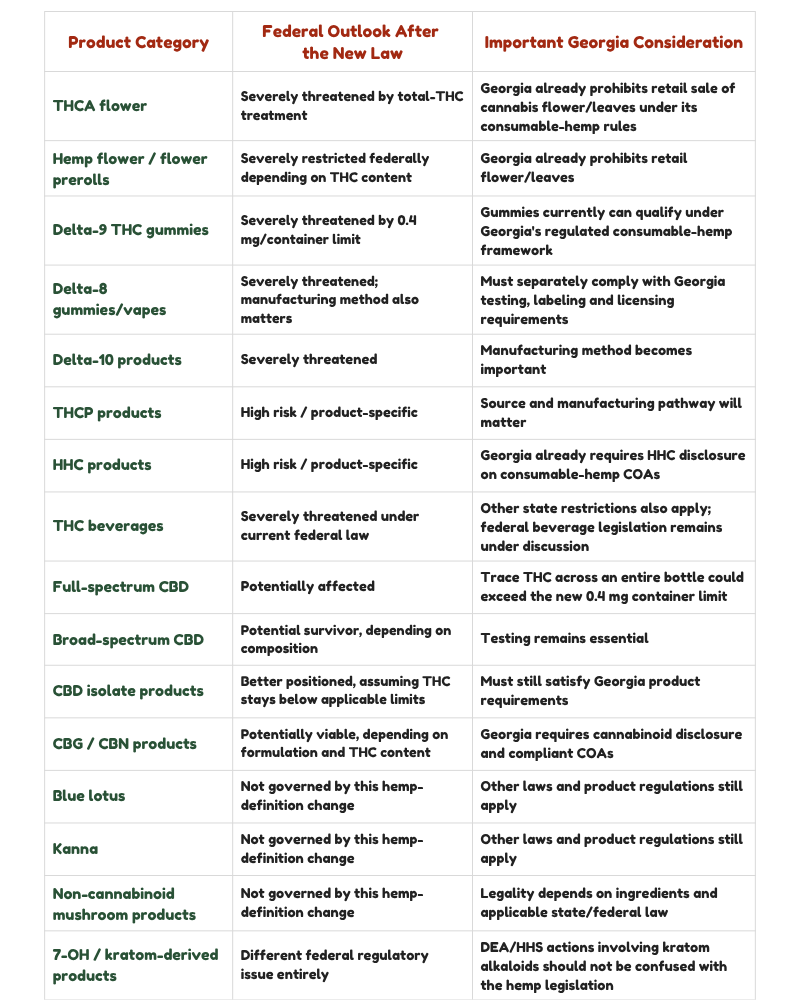
Calling a product “natural,” “hemp-derived” or “Farm Bill compliant” will not determine its status after the new rules take effect.
Actual formulation, cannabinoid concentration, manufacturing method, laboratory results and packaging will matter.
Georgia Law Still Matters
Federal law is only one layer.
Georgia separately regulates consumable hemp products through the Georgia Department of Agriculture.
Georgia currently requires retail consumable-hemp establishments to be licensed and imposes requirements involving testing, certificates of analysis, THC warning labels, packaging and age restrictions.
Retail sales of consumable hemp products are limited to customers 21 and older.
Georgia also prohibits retail sales of cannabis flower and leaves, regardless of their THC concentration.
Consumable hemp products sold in Georgia must have appropriate laboratory testing and a current certificate of analysis showing cannabinoid content, including THC, CBD, CBDA, CBG, CBGA, CBN and HHC, along with required contaminant testing.
So a product must survive both federal and Georgia law to remain a sensible retail product in this state.
Does This Mean Hemp Is Being Banned?
No.
Industrial hemp itself is not being eliminated.
Congress specifically preserved industrial hemp used for things such as stalks, fiber, grain, seed oil and other non-cannabinoid applications.
Likewise, some cannabinoid products containing little or effectively no THC may continue qualifying as hemp.
What Congress has targeted is primarily the market for intoxicating and THC-like hemp-derived cannabinoid products that grew rapidly after passage of the 2018 Farm Bill.
The practical impact, however, could be enormous.
Many gummies, vapes, tinctures and other products consumers currently associate with the legal hemp market will have difficulty meeting a 0.4 mg-per-container ceiling.
Could Congress Change This Again?
Yes.
The debate is far from over.
Members of Congress and industry groups have proposed alternative approaches ranging from delaying the new definition to replacing the near-ban with a regulated market involving potency limits, age restrictions, manufacturing standards, testing and taxation.
That is why December 11 should be viewed as the current federal deadline, not necessarily the final chapter.
But businesses would be taking an enormous risk if they simply assumed Congress will rescue the existing market before then.
What North Georgia Smoke Shop Is Doing
At North Georgia Smoke Shop, we are following these developments closely.
Our approach is straightforward:
We will continue monitoring federal law, Georgia law and regulatory guidance as the deadlines approach.
We are reviewing cannabinoid products based on their actual ingredients, laboratory testing and manufacturing information rather than relying solely on marketing claims.
We are also expanding our focus on compliant products and categories that are less dependent on the legal uncertainty surrounding intoxicating hemp cannabinoids.
If a product can no longer legally be sold, we will not sell it.
At the same time, we believe customers deserve accurate information rather than exaggerated headlines claiming either that “hemp has been banned” or that “nothing is changing.”
A lot is changing.
The important question is what changes, when it changes and which products are actually affected.
We will continue updating this page as Congress, FDA, DEA and Georgia regulators provide additional guidance.
Information current as of September 3, 2026. This article is provided for general educational purposes and is not legal or medical advice. Hemp and cannabinoid laws are changing rapidly, and the legal status of a specific product can depend on its ingredients, laboratory analysis, manufacturing process and jurisdiction.